
| commit | 193a27b5e2a5c60816acd08ce287905478f7e399 | [log] [tgz] |
|---|---|---|
| author | James Farrell <[email protected]> | Wed Aug 07 20:52:45 2024 +0000 |
| committer | Automerger Merge Worker <[email protected]> | Wed Aug 07 20:52:45 2024 +0000 |
| tree | a538fc3063e2d5d30b2630f189eb237303fb753b | |
| parent | b31265b6abff21b214ada7f9e8787c71c044794d [diff] | |
| parent | 01a4e211f47da09fd2cfd52f5977aa2a5fe98d44 [diff] |
Update Android.bp by running cargo_embargo am: 01a4e211f4

Original change: https://android-review.googlesource.com/c/platform/external/rust/crates/uuid/+/3208941

Change-Id: I838e8b4d9ab76c8d79dd61ef6d1fc7ed17a65674
Signed-off-by: Automerger Merge Worker <[email protected]>
uuid

Here's an example of a UUID:
67e55044-10b1-426f-9247-bb680e5fe0c8
A UUID is a unique 128-bit value, stored as 16 octets, and regularly formatted as a hex string in five groups. UUIDs are used to assign unique identifiers to entities without requiring a central allocating authority.
They are particularly useful in distributed systems, though can be used in disparate areas, such as databases and network protocols. Typically a UUID is displayed in a readable string form as a sequence of hexadecimal digits, separated into groups by hyphens.
The uniqueness property is not strictly guaranteed, however for all practical purposes, it can be assumed that an unintentional collision would be extremely unlikely.
Add the following to your Cargo.toml:
[dependencies.uuid]
version = "1.7.0"
features = [
    "v4",                # Lets you generate random UUIDs
    "fast-rng",          # Use a faster (but still sufficiently random) RNG
    "macro-diagnostics", # Enable better diagnostics for compile-time UUIDs
]
When you want a UUID, you can generate one:
use uuid::Uuid;

let id = Uuid::new_v4();
If you have a UUID value, you can use its string literal form inline:
use uuid::{uuid, Uuid};

const ID: Uuid = uuid!("67e55044-10b1-426f-9247-bb680e5fe0c8");
You can also parse UUIDs without needing any crate features:
use uuid::{Uuid, Version};

let my_uuid = Uuid::parse_str("67e55044-10b1-426f-9247-bb680e5fe0c8")?;

assert_eq!(Some(Version::Random), my_uuid.get_version());
If you'd like to parse UUIDs really fast, check out the uuid-simd library.
For more details on using uuid, see the library documentation.
uuid library docs.Licensed under either of
at your option.
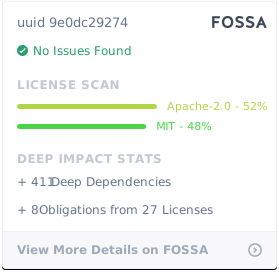
Unless you explicitly state otherwise, any contribution intentionally submitted for inclusion in the work by you, as defined in the Apache-2.0 license, shall be dual licensed as above, without any additional terms or conditions.